Municipality of Radomin
Obory and Szafarnia — a Carmelite sanctuary and the real traces of Chopin
A sanctuary with a Gothic Pietà and the manor where Chopin wrote the “Kuryer Szafarski” — 16 km apart
Read more →A church from 1402, a hero of the Somosierra charge and the room where Dąbrowska wrote “Nights and Days”
Płonne in Radomin municipality is a village that is easy to drive through without stopping. Yet within walking distance there are three places with a history: the Gothic Church of St James, an obelisk to Jan Nepomucen Dziewanowski, the only Pole named in Napoleon's army bulletin after the Battle of Somosierra, and the Larch Hill (Góra Modrzewiowa), where Maria Dąbrowska wrote “Nights and Days”.
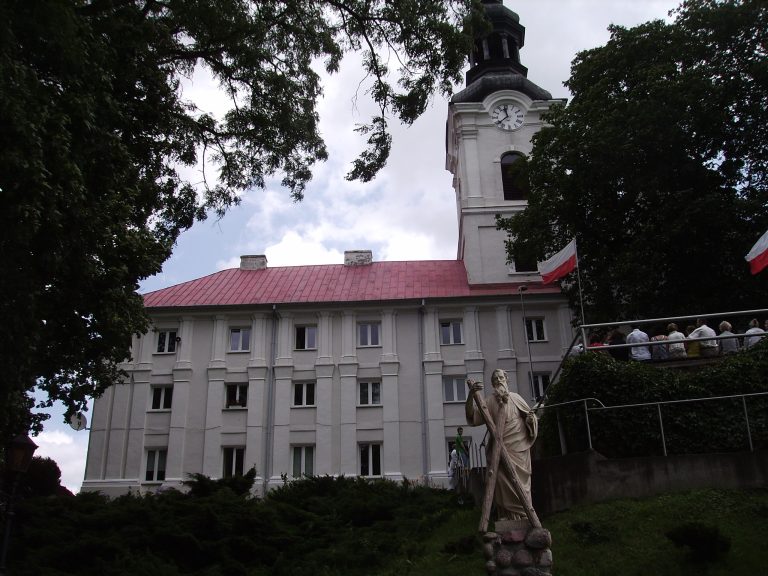
The Gothic Church of St James the Apostle stands on a steep rise. Its construction is dated to 1402, although the Wikipedia description also gives the more general “first half of the 14th century”. It is a brick church, listed in the heritage register under number A/347 of 31 August 1927. The Dziewanowski obelisk stands by the church, on its south side.
The village has a long line of owners. In 1564 the estate belonged to Tomasz Białkowski, and from the second half of the 18th century to the Dziewanowski family. Dominik Dziewanowski, a general of the Polish Army, was born in Płonne in 1759 and returned home in 1814 after Napoleon's defeat. In 1818 he sold the estate to Jan Melchior Piwnicki, who lost it to the partitioning power after the November Uprising. From 1839, after an auction, Płonne belonged to the Łempicki family, who held it until 1939. Remains of the historic manor house and its park survive.
Jan Nepomucen Dziewanowski was born in 1782 (some sources give 1781). The Fryderyk Chopin Institute (NIFC) says that around 1798 he was tutored by Mikołaj Chopin, the future composer's father. Around 1806 Dziewanowski joined the army under General Jan Henryk Dąbrowski. On 30 November 1808, as commander of the 3rd company of the 1st Light Cavalry Regiment of the Guard, he led the charge in the Somosierra pass near Madrid. On the battlefield he was awarded the Legion of Honour on Napoleon's orders. A few days later he died in Madrid of his wounds. In the bulletin of Napoleon's army on the capture of Somosierra, he was the only Pole mentioned by name.
The NIFC also notes that Jan Nepomucen was the brother of Juliusz Dziewanowski, owner of Szafarnia, the uncle of Dominik “Domuś”, Fryderyk's schoolfriend, and the godfather of the composer's elder sister, Ludwika Chopin. The Chopin and Dziewanowski families were thus closely linked. The fourteen-year-old Fryderyk spent the summers of 1824 and 1825 in nearby Szafarnia, with Juliusz Dziewanowski. We describe it in the entry Obory and Szafarnia.
The obelisk in Płonne was unveiled and blessed on 1 August 1926. According to research by a regional historian published on szpejankowski.eu, earlier studies wrongly gave the year as 1925. They were misled by the date on the marble plaques, which were made a year before the ceremony. The monument was erected through the efforts of the social activist Adolf Suligowski, with the help of the owner of Płonne, Ludwik Łempicki, and two descendants of the Dziewanowski family. Major General Leonard Skierski attended the ceremony as the representative of the President of Poland.
A few hundred metres from the church is the Larch Hill, a group of a dozen or so Polish larches covering 0.36 ha, protected as a natural monument. This is where Maria Dąbrowska worked. The writer came to Płonne in 1925, 1926 and 1929 and rented a room from a farmer named Chmiel. From 1925 the estate was managed by her brother-in-law, Stanisław Hepke.
In Płonne Dąbrowska wrote and painted, and she worked here on her novel “Nights and Days” (Noce i dnie). According to Wikipedia, the village became the model for Krępa in the novel. Mementoes of the writer are kept in the Regional Memorial Room at the local primary school. The village also holds the “Serbinów Harvest Festival” (Serbinowskie Żniwobranie), inspired by her writing.
Płonne is in Radomin municipality (Golub-Dobrzyń County, Kuyavian-Pomeranian Voivodeship). The church, the Dziewanowski obelisk and the Larch Hill are all in the same village, within walking distance of each other. The area around the church and the natural monument are open to all. The church stands on a rise, and we have not confirmed any facilities for people with disabilities. Allow 30–45 minutes for all three, or half a day if you combine them with Szafarnia.
A sanctuary with a Gothic Pietà and the manor where Chopin wrote the “Kuryer Szafarski” — 16 km apart
Read more →