The painting with the uncovered ear — the basilica in Rokitno
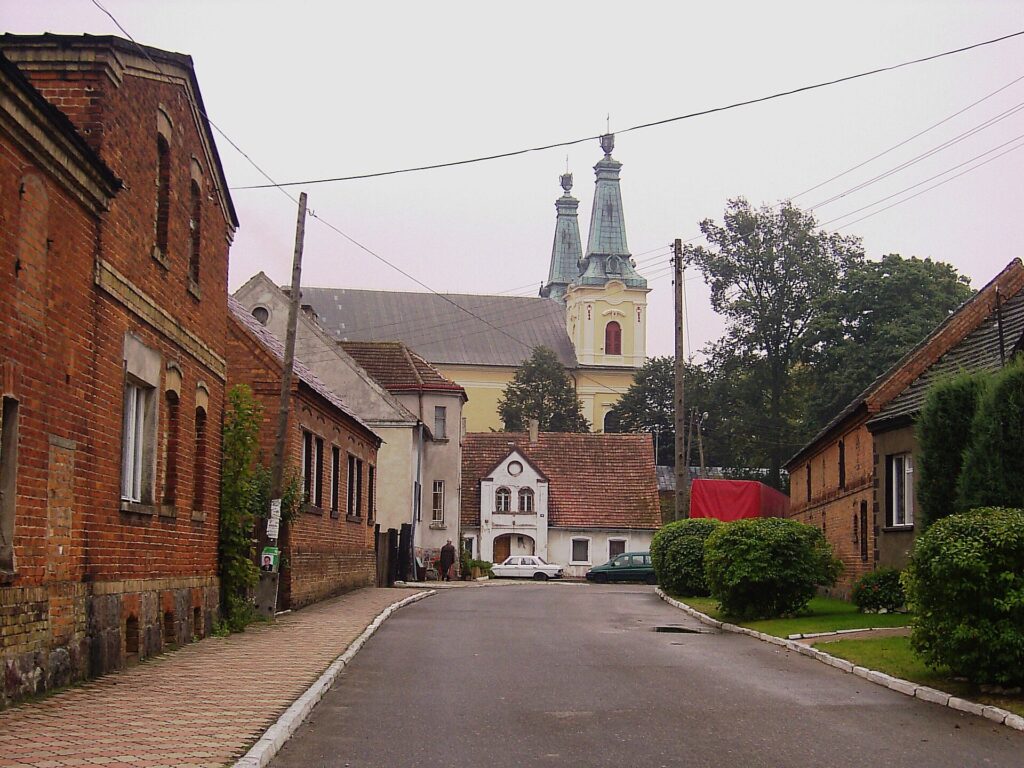
If you drive through Rokitno in Przytoczna municipality, it is hard to miss the Baroque church with two square towers flanking its entrance. It is a minor basilica and the largest Marian shrine in the Zielona Góra–Gorzów diocese. The high altar holds a small early 16th-century painting named after a single detail: Mary's uncovered ear.
A painting brought from Bledzew
The miraculous image of Our Lady Patiently Listening was painted in the early 16th century by masters of the Netherlandish school. It is done on a linden-wood panel and measures only 40 cm by 27 cm. Mary is shown in bust form against a gilded background, her face tilted to the left and her eyes half closed. A halo is carved into the wood, and she wears a muslin veil and a red robe. The uncovered ear gave the painting its nickname and Mary her title of the Patiently Listening.
The painting came to Rokitno in 1669 from the Cistercian abbey in Bledzew. The village had belonged to the Cistercians since the late 14th century: on 18 December 1378 the castellan of Stary Grod, Mikołaj of Bytyń, gave it to Abbot Mikołaj and the monks. Two years after the painting arrived, in 1671, Jan Opaliński enlarged the then still wooden church: he widened the nave, expanded the chancel, introduced a new altar for the painting and added two towers with porches.
Building the present church
A parish probably existed in Rokitno as early as the 12th century, and the first wooden chapel, most likely dedicated to St Michael the Archangel, was founded in 1333 by the Bishop of Poznań, Jan Doliwa. At the start of the 18th century work began on a masonry church, but it was never finished. In 1746 the structure was pulled down and construction of the present church began; it was completed in 1762.
The church has three naves and a rectangular plan, with the chancel on the north side. A sacristy was added to the chancel on the west and a chapel on the east. The sail vaults are decorated with 18th-century polychromy. Look for the Mannerist choir stalls from the mid-17th century, attributed to Hilarion of Poznań. They come from the abbey church in Bledzew, so together with the painting they recall the village's old ties with the monastery. The remaining furnishings are Baroque and Rococo.
Crowns, basilica title and historic monument
The painting was crowned with papal crowns in 1989. In 2002 the church was given the title of minor basilica, and on 20 November 2024 the shrine was declared a Historic Monument. Four indulgence feasts are held here each year: 3 May (Our Lady Queen of Poland), 18 June (Our Lady of Rokitno), the first Sunday of September (the Nativity of the Blessed Virgin Mary) and the first Sunday of October (Our Lady of the Rosary).
Practical information
The basilica stands in Rokitno (address per OpenStreetMap: Rokitno 40), Przytoczna municipality, Międzyrzecz County, Lubusz Voivodeship. It is an active parish church and pilgrimage site, so plan your visit around services. We have no confirmed opening hours or information on facilities for visitors with reduced mobility — please contact the parish before you go. Seeing the interior and the painting usually takes about an hour.
Why it's not a historic gem
The shrine is well known in the region and among pilgrims, so it does not meet the "off the beaten path" criterion.
Sources
- Wikipedia — Bazylika Matki Bożej Rokitniańskiej w Rokitnie — https://pl.wikipedia.org/wiki/Bazylika_Matki_Bo%C5%BCej_Rokitnia%C5%84skiej_w_Rokitnie
- Wikipedia — Rokitno (powiat międzyrzecki) — https://pl.wikipedia.org/wiki/Rokitno_(powiat_mi%C4%99dzyrzecki)
- Niedziela Zielonogórsko-Gorzowska — Sanktuarium w Rokitnie pomnikiem historii — https://zielonagora-gorzow.niedziela.pl/artykul/107379/Sanktuarium-w-Rokitnie-%E2%80%93-pomnikiem-historii
- OpenStreetMap — Bazylika Matki Bożej Rokitniańskiej — https://www.openstreetmap.org/way/256448819