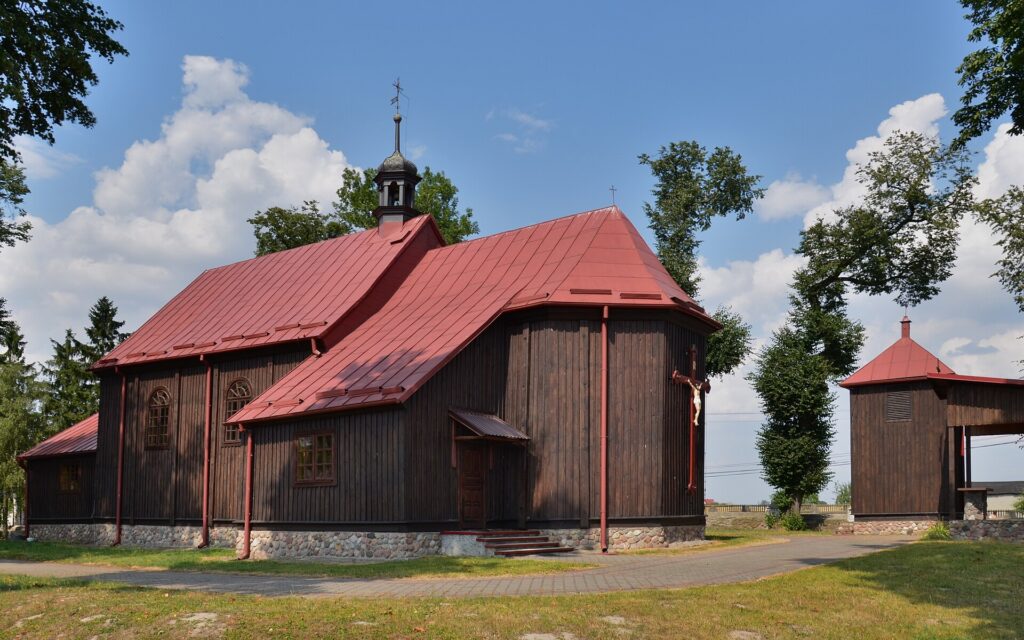
The wooden church in Dulsk — founded by Bishop Działyński in 1737
In Dulsk, a village in Radomin municipality, stands a wooden church from 1737, founded by a bishop of the Działyński family. Until 1909 the parish here included Dobrzyń nad Drwęcą. Inside there is an 18th-century Rococo altar with figures of the Apostles Peter and Paul.
Founded by Bishop Działyński
The church was built in 1737 by the auxiliary bishop of Kuyavia, Aleksander Działyński of the Ogończyk coat of arms. At that time it had three altars. The high altar held a painting of the Crucified Christ, and the side altars paintings of St Nicholas and the Blessed Virgin Mary and of St Roch and St Barbara. In 1878 the church was partly remodelled, and in 1902 Jan Szrejbert of Włocławek built a nine-stop organ in it.
The parish of Dulsk was extensive. Until 1909 it included Dobrzyń nad Drwęcą and the surrounding villages. From the 1860s a curate from Dulsk lived in Dobrzyń, and an independent parish was created there only in 1909.
The war and post-war renovations
After the arrest of the parish priest, Fr Stanisław Nowak, in October 1939 the church stood closed until the end of the war. It was renovated in 1949–1951, in 1956 the interior was repainted through the efforts of Fr Romuald Ignacy Bralczyk, and in 1995–1998 the porch was extended and the walls and floor renewed.
What you will see inside
Today the church has three altars. The high altar is Rococo, with figures of the Apostles Peter and Paul and of Saints Stanislaus and Adalbert, and a painting of the Immaculate Virgin in a dress cover from the second half of the 18th century. The two 18th-century side altars are dedicated to the Holy Trinity and St Roch and to St Thecla and St Nicholas. In recent years the sculptures, paintings and high altar have been restored.
Practical information
Dulsk lies in Radomin municipality (Golub-Dobrzyń County, Kuyavian-Pomeranian Voivodeship), south-east of Golub-Dobrzyń. It is an active parish church, so the interior is easiest to see around services. Allow about half an hour for your visit. It combines well with St Catherine's Church in Dobrzyń, which once belonged to the same parish.
Why it's not a historic gem
An active church opened mainly for services — an interesting stop, but not a destination in itself.
Sources
- Kościół Wniebowzięcia Najświętszej Maryi Panny w Dulsku — Wikipedia — https://pl.wikipedia.org/wiki/Ko%C5%9Bci%C3%B3%C5%82_Wniebowzi%C4%99cia_Naj%C5%9Bwi%C4%99tszej_Maryi_Panny_w_Dulsku
- Kościół p.w. św. Katarzyny w Dobrzyniu — Urząd Miasta Golub-Dobrzyń — https://www.golub-dobrzyn.pl/730,kosciol-p-w-sw-katarzyny-w-dobrzyniu