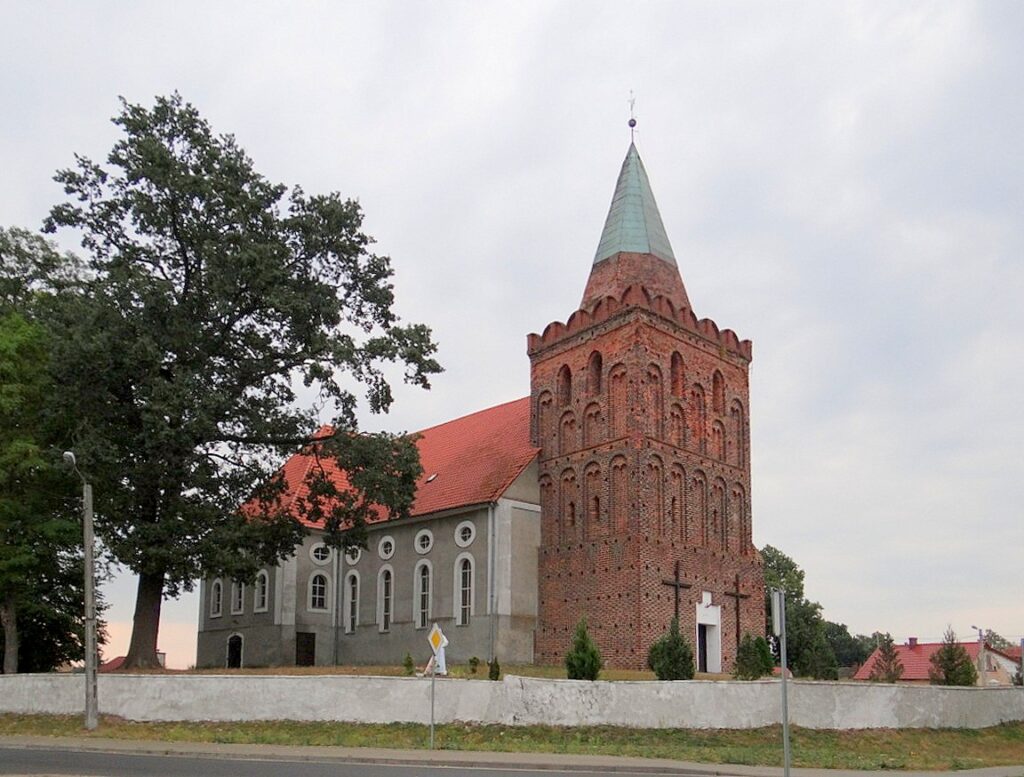
Church in Starosiedle — the third church on the site of a Cistercian foundation
The tower of this church in Starosiedle has stood on the spot since the late Gothic period, and the church itself is already the third one on the same site. Renaissance gravestones survive in its sacristy, and the nave holds a pulpit, a baptismal angel and an organ from 1863; the organ from the castle church in nearby Gębice also ended up here.
The third church on the same site
According to the monuments register, the predecessors of the present church were first a wooden building and then a larger stone church. Today's brick church, a former Protestant church now a Roman Catholic parish church of St John of the Cross, dates back to the 15th century and was rebuilt in the 18th. Johann Casimir von Dallwitz — builder of churches in Starosiedle and nearby Koło — added the body of the church to the late Gothic tower in 1731–1734.
The Dallwitz family owned the village from 1452 to 1798 and furnished the church: they donated a late 18th-century pulpit, a chandelier, a baptismal angel, an altar and a wooden sculpture.
A tower with blind arcades and a princely bell
The church has a single nave and a narrower, three-sided chancel. The tower has blind niches on its façades, an attic-style crown and a brick spire. Its bell was donated by Heinrich von Schönaich-Carolath of the princely family that owned the village at the turn of the 20th century. Inside, under a shared ceiling over nave and chancel, stands an organ from 1863, and the sacristy holds three Renaissance stone tomb slabs from the late 16th century. The organ from the castle church in Gębice came to Starosiedle after the war.
The village of Paul Tillich
The Protestant philosopher and theologian Paul Tillich was born in Starosiedle (German: Starzeddel) on 20 August 1886; he died in Chicago in 1965. The village has a much older history too: in 1228 Margrave Henry the Illustrious of Meissen founded a Cistercian monastery here, moved in 1288–1291 to Neuzelle. In 1645 Swedish and Saxon troops fought under the church walls and the village was completely destroyed.
Practical information
Starosiedle lies in Gubin rural municipality, Krosno County. It is an active parish church — you can see the interior only outside services; the sources give no opening hours, so it is best to ask the parish. Allow about 30–45 minutes for the church and the village. No information about accessibility for people with limited mobility was found.
Why it's not a historic gem
A known registered monument, but not an off-the-beaten-path place.
Sources
- Starosiedle — Wikipedia — https://pl.wikipedia.org/wiki/Starosiedle
- Gębice (powiat krośnieński) — Wikipedia — https://pl.wikipedia.org/wiki/G%C4%99bice_(powiat_kro%C5%9Bnie%C5%84ski)
- Rejestr zabytków nieruchomych woj. lubuskiego — NID — https://www.nid.pl/pl/Informacje_ogolne/Zabytki_w_Polsce/rejestr-zabytkow/zestawienia-zabytkow-nieruchomych/LBS-rej.pdf