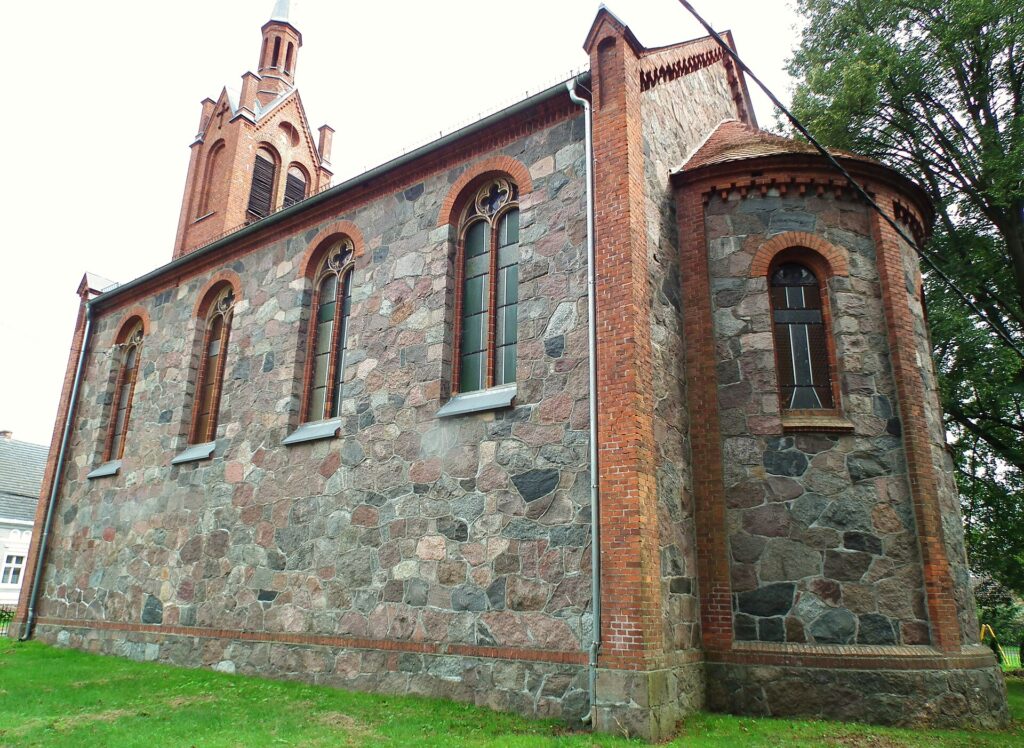
Church in Tursk — neo-Gothic with bells from the old church
If you get to Tursk, you will find a neo-Gothic church of 1852 built on the village green. Bells from the old church were moved into it, one from the turn of the 15th century. For centuries the village belonged to the Knights of St John.
A village of the Knights of St John
In the 14th century Tursk belonged to the Łagów commandery of the Order of St John and remained in it until secularisation in 1810. The first mention of the church dates from 1598, though a church may have stood here two hundred years earlier. After the 16th century it lost its parish status.
A new church on the green
The old church was in very poor technical condition, so in 1852 a new one was built elsewhere, on the so-called village green. Its style is neo-Gothic. Part of the furnishings moved there: 16th-century candlesticks and bells from 1600 and from the turn of the 15th century.
After 1945 the church was taken over by Catholics and in September 1951 it was consecrated as St Stanislaus. The heritage register lists it as a former Protestant church of 1840, while Wikipedia gives 1852, so sources differ on the date of construction.
Practical information
Tursk is in Sulęcin municipality (Sulęcin County, Lubusz Voivodeship). Viewing the outside takes about fifteen minutes. Check with St Henry's parish in Sulęcin whether the interior is open.
Why it's not a historic gem
Known mainly locally; a village neo-Gothic church without regionally exceptional features.
Sources
- Wikipedia — Kościół św. Stanisława w Tursku — https://pl.wikipedia.org/wiki/Ko%C5%9Bci%C3%B3%C5%82_%C5%9Bw._Stanis%C5%82awa_w_Tursku
- Wikipedia — Tursk — https://pl.wikipedia.org/wiki/Tursk_(wojew%C3%B3dztwo_lubuskie)