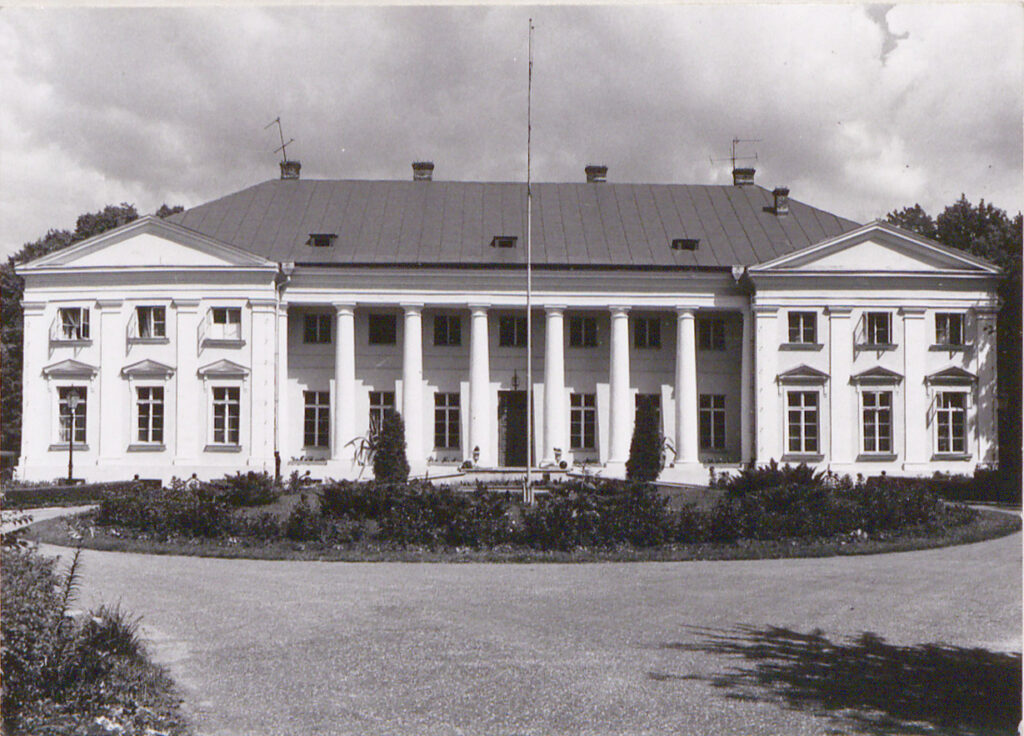
The Palace in Kikół — where the young Chopin stayed
If you have driven along the “ten” (national road 10) through Kikół, you passed within a few hundred metres of it. This is the Neoclassical palace of the Zboiński family, with a deep portico on six columns, built around 1790, probably to a design by Stanisław Zawadzki. In the summer of 1827 Fryderyk Chopin visited it. Today the palace is privately owned and you see it from outside, but its history spans two centuries of Kuyavia.
The voivode who founded a town and built a palace
Kikół appears in documents as early as 1236 as Kychol. The Fryderyk Chopin Institute (NIFC) notes that it was destroyed in a Prussian raid in the mid-13th century, and in 1395 its then owner, John of Kikół, sold the estate to the Teutonic Knights. The Zboiński family held Kikół from 1695, and it was they who turned the village into a town. Ignacy Antoni Zboiński, Voivode of Płock, obtained permission from King Augustus III to found a town here in 1745.
The same Zboiński had a Neoclassical palace with a garden and an orangery built in 1790. The design is attributed to Stanisław Zawadzki, but the NIFC cautiously says “probably”, and we keep that caution. Arlan gives a different date, around 1792. The palace has two storeys and a rectangular plan, with shallow projections at the ends of the façade. Between them is a recessed portico with Tuscan columns. On the park side, deep corner projections extend outward.
The voivode's son, Franciszek Ksawery, inherited the estate in 1796 and funded a brick church, where he was buried together with his wife Joanna, née Grabieńska. Today's Neo-Gothic Church of St Adalbert was built on its site in 1904–1909.
Chopin in Kikół — what we know for certain
From 1818 the estate belonged to Karol Zboiński. According to the NIFC, Fryderyk Chopin visited him in the summer of 1827 on his way from Rościszewo to Gdańsk. The Institute notes that no details of this stay are documented. Chopin may have come here earlier, as he spent the summers of 1824 and 1825 in Szafarnia, about 30 km to the north (we describe it in the article Obory and Szafarnia). The Polskie Zabytki website and the Arlan studio say Chopin was in Kikół in 1825. The difference in dates shows how little is known about these visits.
Local tradition says Chopin played for the guests in the Knights' Hall. This two-storey room in the eastern part of the palace is the only interior where the rich decoration has survived, including trompe-l'œil paintings with architectural motifs from the turn of the 18th and 19th centuries. The NIFC also points to an indirect link between the Zboińskis and Chopin's family. In 1800 Franciszek Ksawery Zboiński bought an estate in Izbica Kujawska, where Justyna Krzyżanowska, the composer's future mother, lived before she joined the Skarbek family at Żelazowa Wola and met Mikołaj Chopin there.
A park, its owners and two centuries of change
In the 1840s Karol Zboiński laid out an English-style landscape park around the palace. In 1909 it was redesigned by Stefan Celichowski, and in 1926 a pond with a dyke and a weir was dug. Today the park covers about 12 hectares and is on the heritage register. In 2005–2008 it was restored with the involvement of John Brookes and Jarosław Małecki. During the work 2,580 large trees and shrubs were planted and 60 were transplanted.
The Zboińskis held Kikół until 1855. The estate then passed to the Piwnicki family, and in 1902 to Władysław Nałęcz and his wife Franciszka Jadwiga, née Krasińska. After an auction in 1937 it was taken over by the Chełmica sugar factory, and from 1945 it belonged to the State Treasury. Kikół lost its town rights as punishment for its residents' part in the January Uprising (sources give 1867 or 1870). It regained them only on 1 January 2024.
The palace, damaged during the war, was rebuilt in 1966 to a design by Jan Tejchman, and for years it housed a holiday and training centre. Today the palace and park complex is private and belongs to Roman Karkosik, the founder of the Our Lady of Mercy monument in Konotopie in the same municipality.
Practical information
The palace stands at ul. Henryka Sienkiewicza 17 in Kikół, about 300 m from the market square (Kikół municipality, Lipno County, Kuyavian-Pomeranian Voivodeship). The “Navigate” button takes you to the palace. It is private property, and the interiors, including the Knights' Hall, are not open to visitors, so you see the palace from the road. About 15 minutes is enough. It is best combined with Szafarnia and Konotopie in a single route. Access may change, so check before you go.
Why it's not a historic gem
Private property, seen only from the outside — and a historic gem must be physically accessible to visitors.
Sources
- Narodowy Instytut Fryderyka Chopina — katalog miejsc: Kikół — https://greatcomposers.nifc.pl/pl/chopin/catalogs/places/130
- Polskie Zabytki — Kikół, pałac — http://www.polskiezabytki.pl/m/obiekt/1070/Kikol/
- Arlan — Park zabytkowy w Kikole (rewaloryzacja 2005–2008) — https://arlan.pl/park-zabytkowy-w-kikole-jeden-z-najpiekniejszych,59,pl.html
- Fotopolska — Kikół, Pałac Zboińskich — https://fotopolska.eu/Kikol/b70274,Palac_Zboinskich.html
- Wikipedia — Kikół — https://pl.wikipedia.org/wiki/Kik%C3%B3%C5%82
- OpenStreetMap — Pałac Zboińskich, ul. Henryka Sienkiewicza 17, Kikół — https://www.openstreetmap.org/way/306179811