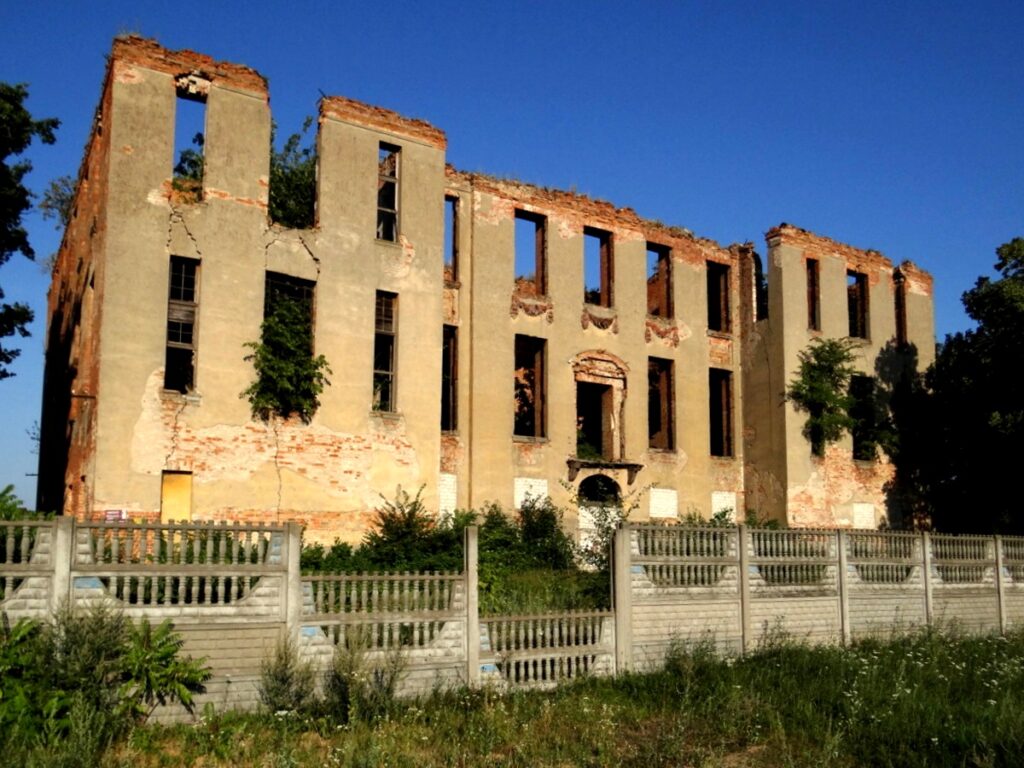
Hospitaller Castle in Słońsk — a ruin with Dutch roots
If you drive route 22 from Kostrzyn towards Gorzów, it is easy to pass Słońsk without noticing — yet it is worth stopping at Plac Zamkowy. The walls here belong to the former Hospitaller commandery: first a medieval castle, then a baroque palace modelled on a Dutch one. It has been a ruin since 1975, but its mass is still impressive.
From a knight's manor to a Hospitaller seat
A small knight's manor from the 14th century once stood here. The turning point came on 20 March 1426, when the Order of St John acquired the town and castle of Słońsk (then Sonnenburg) and made it the seat of its Brandenburg branch. A mighty fortress was built in 1426–1429 and housed the Order's commander. Thick walls from that period survive within the later structure.
The first major extension took place in 1545–1564 under Master Tomasz Runge. The castle gained a Renaissance look, known from an engraving by Matthäus Merian, who recorded its east and north façades. This stage ended in 1652, when the Swedes burned the castle down.
A baroque residence modelled on Amsterdam
Rebuilding was initiated in 1662 by the Master of the Order, Prince Johann Moritz of Nassau, and lasted until 1688. The new residence reused the old walls and followed a palace in Amsterdam designed by Jacob van Campen and Pieter Post. The Dutch masters Cornelis Rykwaert and Gorus Peron led the work, supervised by the prince's building adviser Jean de Bonjour.
The complex has a square plan: a residential wing in the east, a courtyard enclosed by a low wall, a moat around the whole, and a garden on the axis. Another rebuilding followed in 1783. In the 19th century the castle housed a museum and archive of the Hospitaller Order.
After 1945: a cultural centre and a fire
After the war the town took over the castle. For a time it served as a cultural centre, but around 1970 it was abandoned, and in 1975 it was set on fire. Since then only roofless walls remain. The castle belongs to one ensemble with the Church of Our Lady of Częstochowa, its former chapel, and the palace park.
Practical information
The castle is in Słońsk (Słońsk municipality, Sulęcin County), at Plac Zamkowy, on the Łęcza river. It is a roofless ruin — do not enter, it may collapse; view it from the outside only. 20–30 minutes is enough, ideally combined with the nearby church.
Why it's not a historic gem
The site can only be viewed from the outside (a ruin at risk of collapse), so it does not meet the physical-accessibility requirement for an icon.
Sources
- Zamek joannitów w Słońsku — Wikipedia — https://pl.wikipedia.org/wiki/Zamek_joannit%C3%B3w_w_S%C5%82o%C5%84sku
- Słońsk — Wikipedia — https://pl.wikipedia.org/wiki/S%C5%82o%C5%84sk