The former psychiatric hospital in Owińska — the murder of its patients in 1939
In the autumn of 1939 the psychiatric hospital in Owińska near Poznań had about 1,100 patients. That same autumn the Germans began murdering them. An SS unit commanded by Herbert Lange took them to the forests near Oborniki and to Fort VII in Poznań, where they were killed with gas. According to the Institute of National Remembrance (IPN), this was part of the campaign to exterminate psychiatric patients in the Wartheland.
The first psychiatric hospital in Greater Poland
The hospital opened in January 1838 inside the walls of the dissolved Cistercian convent. The Owińska parish gives the date as 25 January. It was the first psychiatric hospital in Greater Poland and, according to the Puszcza Zielonka Landscape Park portal, the only one of its kind in the Province of Posen until 1920. Its first directors were Friedrich Wilhelm Christian Beschorner and Karl Wilhelm Werner.
The hospital grew quickly. The parish records 120 patients in 1871 and 204 in 1878. In 1880 it was enlarged under the supervision of Heinrich Laehr, and by 1911 it had 750 beds. The former convent was also remodelled for the hospital's needs (in 1873–1875). The surviving hospital buildings are on the heritage register under number 22/A of 6 April 2000.
Autumn 1939: Sonderkommando Lange and Fort VII
In September and October 1939 the German authorities took over the psychiatric hospitals in occupied Greater Poland. In November the extermination of patients began. It was carried out by a special unit commanded by Herbert Lange, a criminal police commissioner and SS-Obersturmführer. According to the IPN, it consisted of 15 Security Police officers and 60 policemen.
Patients from Owińska were taken to two places. Some were shot in the forests near Oborniki. Others were taken to Fort VII in Poznań. There, as the IPN describes, they were locked in a bunker whose openings prisoners sealed with clay, and gas was piped in from a cylinder standing outside the entrance. Later the unit used a gas van fed with carbon monoxide to kill patients in the Wartheland. The Martyrdom Museum in Żabikowo calls Fort VII the first camp where the Germans used gas for the mass murder of civilians.
The numbers of victims differ between sources. The IPN states that 1,000 patients of the Owińska hospital and 27 patients of the psychiatric ward of the Poznań Municipal Hospital were murdered in this way. The Żabikowo museum writes of more than 1,100 people murdered from Owińska. A 2014 report on the IPN investigation mentions 400 patients gassed at Fort VII. These figures need not contradict each other, as some victims died in the forests near Oborniki, but the full toll cannot be established today. The Germans destroyed all the records of the Owińska patients. Unlike the hospitals in Kościan and Gniezno, no lists of patients have survived.
The crime in Owińska was one of the first stages of a wider campaign. According to dzieje.pl, about 6,000 psychiatric patients in total were murdered in the Wartheland by August 1941. Herbert Lange later became the first commandant of the Kulmhof extermination camp in Chełmno nad Nerem.
After the crime: labour camp, youth institution, ruin
From 1943 until January 1945 the grounds housed Arbeitslager Treskau, a subcamp of the German Gross-Rosen concentration camp. After the war, from 1952 to 1993, there was a youth correctional institution here, and later a social care home. Today the former hospital buildings and the adjoining land belong to a private owner and are falling into decay.
Since 1998 the investigation into the crime has been conducted by the IPN's Branch Commission for the Prosecution of Crimes against the Polish Nation in Poznań. It was reopened in November 2013, and in March 2014 the prosecutors appealed for witnesses and victims' families to come forward. Several dozen people responded. Every year on 22 September Poland marks the Day of Remembrance of the Victims of the Extermination of People with Mental Disorders in Occupied Poland during the Second World War.
Commemoration and practical information
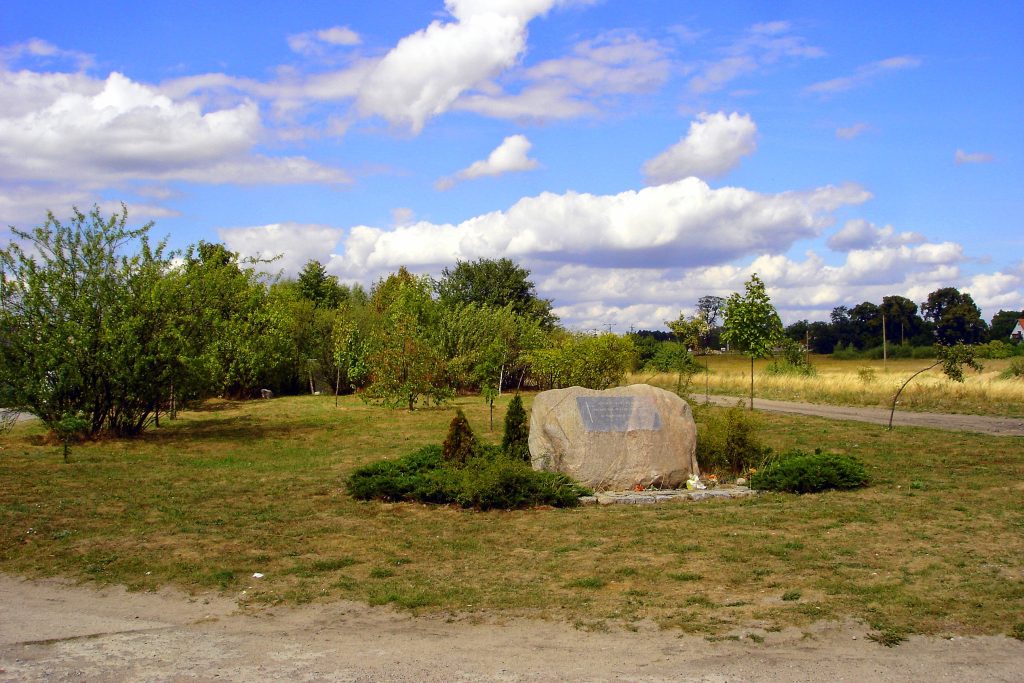
According to OpenStreetMap data, on the site of the former hospital cemetery, on the eastern edge of Owińska, there is a stone placed by local residents in 2003. Its inscription reads: “Site of the former cemetery of the institution for the mentally ill in Owińska 1838–1940”. The “Navigate” button takes you to this spot.
The former hospital buildings are a decaying ruin on private land. Do not go inside or onto the grounds: they are at risk of collapse, and entering is trespassing. View them only from the public road. In Poznań, the history of the crime is documented by the Martyrdom Museum of the Greater Poland People – Fort VII, the very place where the patients from Owińska were taken.
Commemoration
A stone on the site of the former hospital cemetery (local residents, 2003); the crime is documented by the Fort VII Martyrdom Museum in Poznań
Sources
- IPN — Eutanazja — ukryte ludobójstwo pacjentów szpitali psychiatrycznych w Kraju Warty i na Pomorzu — https://ipn.gov.pl/pl/aktualnosci/585,Eutanazja-ukryte-ludobojstwo-pacjentow-szpitali-psychiatrycznych-w-Kraju-Warty-i.html<br />
- Muzeum Martyrologiczne w Żabikowie — Owińska. Szpital psychiatryczny — https://zabikowo.eu/22-owinska-szpital-psychiatryczny/<br />
- dzieje.pl — Nowi świadkowie ws. mordowania pacjentów szpitala w Owińskach w 1939 r. — https://dzieje.pl/aktualnosci/nowi-swiadkowie-ws-mordowania-pacjentow-szpitala-w-owinskach-w-1939-r<br />
- Muzeum Kulmhof w Chełmnie nad Nerem — Dzień Pamięci Ofiar Zagłady Osób z Zaburzeniami Psychicznymi — https://chelmno-muzeum.eu/dzien-pamieci-ofiar-zaglady-osob-z-zaburzeniami-psychicznymi-na-terenach-okupowanej-polski-podczas-ii-wojny-swiatowej-2/<br />
- Nasza Zielonka (Park Krajobrazowy Puszcza Zielonka) — Szpital psychiatryczny w Owińskach — https://naszazielonka.pl/places/opuszczony-szpital-psychiatryczny-w-owinskach/<br />
- Parafia św. Jana Chrzciciela w Owińskach — Początki — https://owinska.pl/poczatki-owinska-i-okolice/<br />
- OpenStreetMap — Miejsce byłego cmentarza zakładu dla psychicznie chorych — https://www.openstreetmap.org/node/3044494032