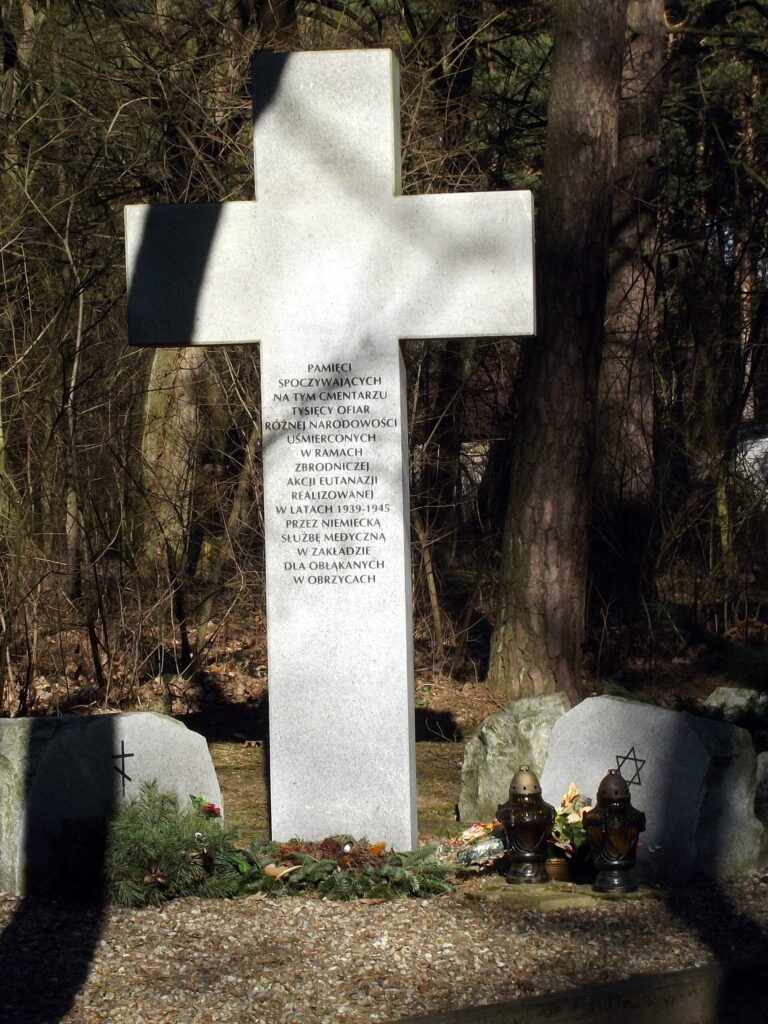
Obrzyce — memorial to the victims of Nazi "euthanasia" at the Obrawalde hospital
In the cemetery of the former psychiatric institution in Obrzyce, in the eastern part of Międzyrzecz, stands a white cross with a Polish dedication, and at its foot two pale stones — one bearing an Orthodox cross, the other a Star of David. The monument, erected in 2004, commemorates patients murdered in the Nazi "euthanasia" programme. Estimates put their number at between 10,000 and 18,000.
A hospital meant to be a model
The institution at Obrzyce (German: Obrawalde) was built in the early 20th century, 2–3 km east of the town centre, and opened on 2 November 1904. It was designed in Gothic Revival style as a self-contained small town, with patient pavilions, a church, a mortuary and staff housing. According to historian Andrzej Kirmiel, it was regarded as one of the most modern institutions in eastern Germany, with exemplary treatment methods. Jewish patients from all over Germany were also treated here and had a prayer room in the administration building.
1942–1945
On 1 September 1939 the Nazis began killing the mentally ill in an operation euphemistically called "mercy death" (Aktion T4). After protests by part of the German clergy the operation was halted, and in 1942 it was secretly resumed in provincial institutions. At Obrzyce the killing of patients began in the summer of 1942 and continued until January 1945. Patients were brought here from all over the Reich, mainly from Berlin, but also from Hanover and Hamburg.
According to Kirmiel, before the operation began the SS took Jewish patients away from the hospital in so-called grey buses to an unknown destination. Nurse Marianna Grocholewska recalled 8–10 large buses arriving, and SS men throwing a patient who was having an epileptic seizure onto the floor of a vehicle. The so-called Book of the Dead records 6,991 deaths between 1 January 1942 and 21 January 1945, almost all of them murdered patients. It is estimated that another 2,000–3,000 people died as a result of deliberate maltreatment, so according to Kirmiel the total number of victims may have been around 10,000. The State Fund for the Rehabilitation of Disabled Persons (PFRON) gives estimates of 10,000 to 18,000, including children, women and elderly people, and states that no other hospital involved in Aktion T4 saw so many people killed. We give both figures because the sources differ.
Commemoration
The hospital cemetery at ul. Długa 23 was divided into denominational sections — Protestant, Catholic and, furthest north, Jewish — all of which are badly damaged today. Opposite the former Jewish section, an area was set aside for the monument unveiled in November 2004; its symbolism also refers to Judaism and commemorates the Jewish victims. Beside it lie small plaques bearing three- and four-digit numbers. On the hospital grounds there is an obelisk from 1966, and the administration building houses a Memorial Room with a permanent exhibition about the crime. The Museum of the Międzyrzecz Land notes that the Memorial Room is not open to tourists at weekends.
The hospital still operates today as the Independent Public Hospital for Nervous and Mental Diseases in Międzyrzecz. Remember that it is a working medical facility: keep quiet and respect patients' privacy. Ask the hospital about visiting the Memorial Room. The Museum of the Międzyrzecz Land also organises historical walks around the hospital complex, and the institution's history is described in Katarzyna Sztuba-Frąckowiak's book "Szpital Psychiatryczny w Obrzycach 1904–1945. Cienie z przeszłości" (The Psychiatric Hospital in Obrzyce 1904–1945: Shadows of the Past).
Commemoration
Monument in the hospital cemetery at ul. Długa 23 (2004), obelisk on the hospital grounds (1966), Memorial Room in the hospital administration building
Sources
- Andrzej Kirmiel — Międzyrzecz-Obrzyce (Uniwersytet w Poczdamie, projekt cmentarzy żydowskich, PDF) — https://www.uni-potsdam.de/fileadmin/projects/juedische-friedhoefe/Dokumente_Pl/Friedhof_Miedzyrzecz_Obrzyce/Kirmiel_Meseritz-Obrawalde.pdf
- Uniwersytet w Poczdamie — Cmentarz zakładu Obrawalde w Międzyrzeczu-Obrzycach (A. Geißler-Grünberg) — https://www.uni-potsdam.de/de/juedische-friedhoefe-pl/friedhof-miedzyrzecz-obrzyce/anlage-des-friedhofs
- PFRON Oddział Lubuski — Upamiętnienie akcji T-4 w Szpitalu Psychiatrycznym w Międzyrzeczu-Obrzycach (2025, PDF) — https://cms-v2-files.idcom-jst.pl/sites/39/wiadomosci/120095/files/tekst.pdf
- Urząd Marszałkowski Województwa Lubuskiego — Pamięć o historii szpitala w Obrzycach jest ważna (20.06.2025) — https://lubuskie.pl/wiadomosci/24409/pamiec-o-historii-szpitala-w-obrzycach-jest-wazna
- Muzeum Ziemi Międzyrzeckiej — Spacer historyczny po Obrzycach (2026) — https://muzeum.miedzyrzecz.pl/spacer-historyczny-po-obrzycach/
- ESJF — Miedzyrzecz (Obrzyce) Jewish Cemetery — https://www.esjf-cemeteries.org/survey/miedzyrzecz-obrzyce-jewish-cemetery/
- Wikipedia — Obrzyce — https://pl.wikipedia.org/wiki/Obrzyce