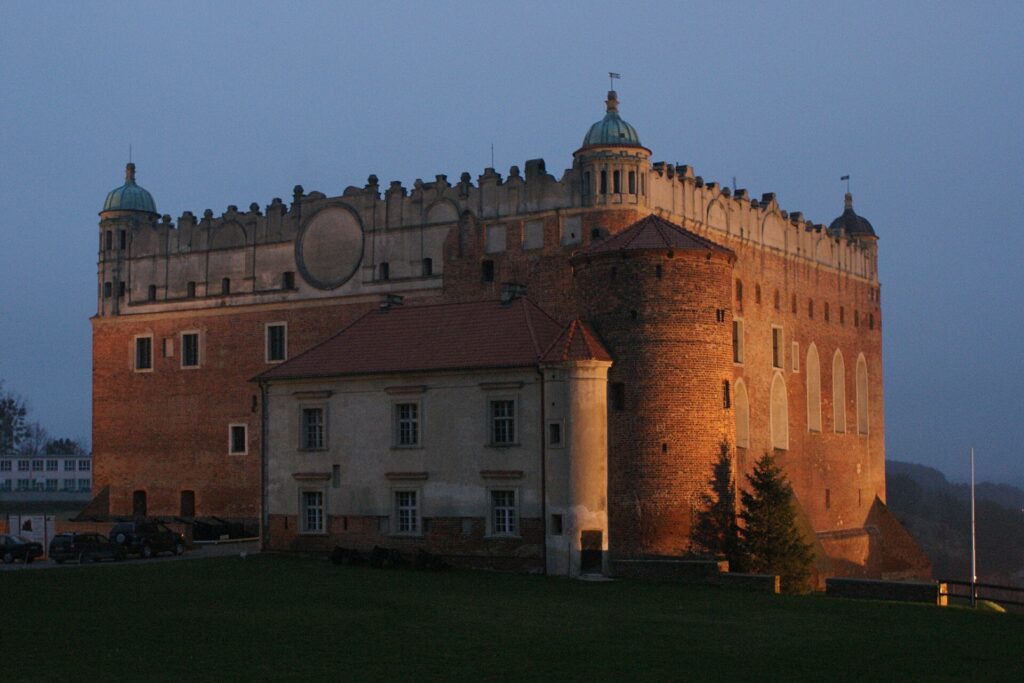
Golub Castle — a Teutonic fortress that Anna Vasa turned into a residence
An early 14th-century castle above the Drwęca: sieges, the Golub War and a princess's Renaissance parapets.
If you enter Golub-Dobrzyń along the Drwęca valley, you will see a brick quadrangle crowned with Renaissance parapets on the hill above the town. This is the castle the Teutonic Knights began building in the early 14th century to guard the crossing over the Drwęca. Three hundred years later Anna Vasa, sister of King Sigismund III, turned it into a residence. Today it houses a museum, a hotel and a restaurant, and it is open to visitors every day.
A river stronghold that became an Order fortress
Before the walls went up, a wooden stronghold on the hill guarded the river crossing. In 1258 the settlement of Golube belonged to the Bishop of Włocławek, and in 1293, through an exchange between the bishopric and the Order, it passed to the Teutonic Knights.
The brick castle was begun in 1304–1306 on the initiative of the Land Master Konrad Sack. First came the perimeter wall, then the south wing with the Chapel of the Holy Cross and the refectory, and finally the east and north wings. Work on the main corner tower was abandoned, and a cylindrical tower already adapted for firearms was built in its place. The commander lived in the west wing, while the brethren slept in the dormitory in the east wing.
Sieges: from Łokietek to the Golub War
Between 1329 and 1333 King Władysław Łokietek tried three times to take the castle, each time without success. In 1410 the Order's troops marching to Grunwald gathered here, and the local commander Nicolaus Roder was killed in the battle. In the autumn of that year, Polish knights led by Dobiesław Puchała defeated larger Livonian forces beneath the castle walls.
The castle fell only in 1422, during the war later named after it, the Golub War. From 20 August it was bombarded by 14 of Jagiełło's cannons, and on 26 August Polish troops took it by storm. It became part of Poland for good after the Peace of Toruń in 1466 and from then on served as the seat of royal starostas.
Anna Vasa and the Renaissance parapets
The castle owes its present silhouette to Anna Vasa, who held the Golub starosty. In 1616–1623 late-Renaissance parapets and corner turrets were added, the windows were reshaped and a building was put up on the barbican. In 1623 her brother, King Sigismund III, stayed here. According to tradition, tobacco brought from Turkey was grown in Poland for the first time here in Golub.
Later the castle suffered badly: the Swedes damaged it in 1655, it served as a military hospital during the Napoleonic Wars, and in 1867 a hurricane-force wind brought down part of the parapets. A museum opened here in 1920, and a thorough reconstruction took place in 1959–1966. In 1977 the castle hosted a knights' tournament, one of the first historical re-enactments of its kind in Poland.
Practical information
The castle stands on a hill above the Golub part of the town of Golub-Dobrzyń (Golub-Dobrzyń County, Kuyavian-Pomeranian Voivodeship). In season, from 1 May to 30 September, it is open from 9:00 to 19:00 (last entry at 18:00), and out of season from 9:00 to 17:00 (last entry at 16:00). A standard ticket costs 30 zł, a reduced ticket 20 zł, and children and young people up to 16 pay 15 zł. Individual visitors explore on their own with a map from reception; guided tours are available for groups of at least five. Parking by the castle is paid (the first 10 minutes are free, then 5 zł for the first hour). Allow one and a half to two hours. This information is as of November 2026, so check current hours and prices on the castle's website before you go.
Why it's a historic gem
- Has a story to tell
- Won't be in the top guidebook picks
- Worth the detour
- Stirs emotion
Sources
- Zamek w Golubiu — Wikipedia — https://pl.wikipedia.org/wiki/Zamek_w_Golubiu
- Zwiedzanie zamku — Zamek Golub — https://www.zamekgolub.pl/zwiedzanie-zamku/
- Zamek golubski w średniowieczu. Architektura i technika budowy — academia.edu — https://www.academia.edu/40973942/Zamek_golubski_w_%C5%9Bredniowieczu._Architektura_i_technika_budowy