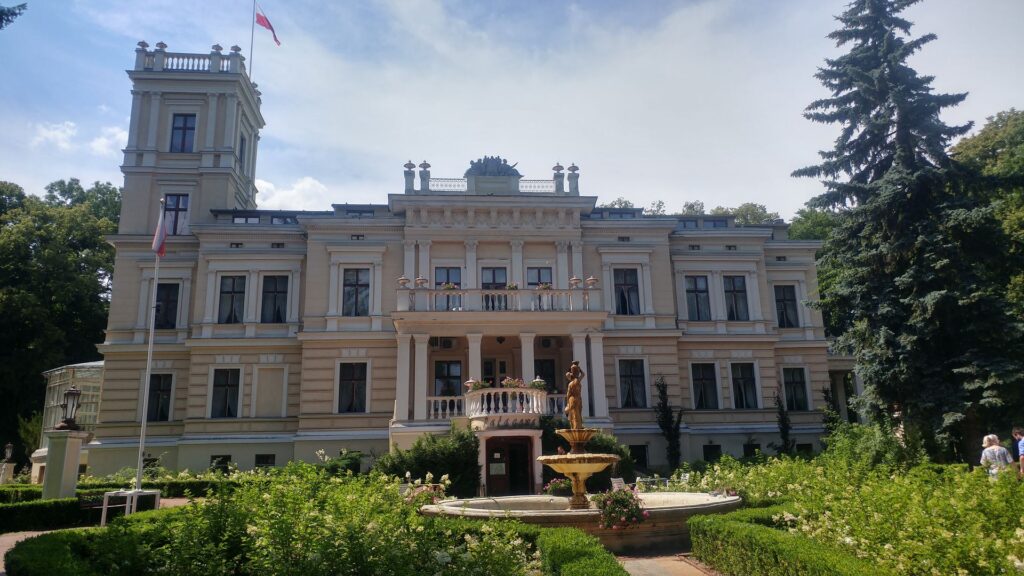
Biedrusko Palace — the von Treskow residence that became an imperial training camp headquarters
For more than a century Biedrusko near Poznań has lived in the shadow of a military training ground. At its centre stands the Neo-Renaissance von Treskow palace, known locally as the castle, which was visited by Kaiser Wilhelm II, Marshal Foch and King Carol II of Romania. Nearby are a Prussian water tower with a clock from 1902, an officers' mess and the Pantheon of the Greater Poland Uprising. Today the palace houses a hotel with a restaurant and a military museum.
From the nuns to an imperial training ground
For almost 300 years, from 1518 to 1797, Biedrusko belonged to the Cistercian nuns of Owińska. In 1797 the Prussian authorities confiscated the convent's estates, which were bought by the Berlin merchant Sigismund Otto Joseph von Treskow. His family owned Biedrusko for more than a hundred years. The last of them, Albrecht Otto Maximilian von Treskow (1845–1901), built the palace that still stands. It was designed by Ludwig Huhn of Gorzów Wielkopolski. Sources give different construction dates: Wikipedia says 1877–1881, the palace's website 1877–1880 and the municipality guide 1877–1888. The building is Neo-Renaissance, with references to classical forms in the interiors.
In 1904 the heirs sold the estate to the Prussian army, which was looking for a training area. The Prussians renamed the village Weissenburg and set up a training camp (Truppenübungsplatz Posen). The palace became the commander's headquarters and an officers' mess. Barracks, depots, smithies, stables, workshops, a small steam power station, a hospital, a veterinary clinic, a post office and a sawmill were built.
Wikipedia lists among the palace's guests Kaiser Wilhelm II (1910), President Ignacy Mościcki (1928) and King Carol II of Romania (1937). The municipality guide adds Marshals Józef Piłsudski, Ferdinand Foch and Edward Rydz-Śmigły. In the first days of the Greater Poland Uprising, insurgents seized the training ground and its stores of weapons. Afterwards the Polish, German and again Polish armies trained here in turn. After 1945 the palace housed an officers' club. In 2009 it was privatised and renovated.
The water tower, the officers' mess and the mural
The most distinctive feature of Biedrusko's skyline is the water tower of 1902. It is about 31 metres tall and supplied water to the officers' mess and the barracks. A clock was fitted on all four sides, striking the hours and quarters, because the soldiers in training had no watches. The tower was taken out of service in 1993; the clock was restored in 2016, and the façade and interior a year later. It stands on military land and is not open to visitors, so you view it from the street.
The officers' mess was built around 1904 for officers of the Prussian army, and after 1918 it was taken over by the Polish Army. From the mid-1990s it fell into decay until a private investor bought it and began restoring it. Along the walking route there is also a mural marking the centenary of Polish independence and of the outbreak of the Greater Poland Uprising, designed by Anna Waluś and Mark Maksimovich. It shows three riflemen of the 7th Greater Poland Mounted Rifles Regiment against the insurgents' flag, the water tower and the palace. On the military base in the centre of the village stands a mast with a ball; until recently, raising the ball told residents that exercises were under way on the training ground.
The park, the museum and the Pantheon
The palace is surrounded by a 14-hectare landscape park with an amphitheatre, the “Lovers' Sighs” gazebo, two ponds and a fountain. At the park entrance is the Pantheon of the Greater Poland Uprising, which commemorates the insurgents and presents the fighting on all fronts of the uprising. Since mid-2014 the palace has housed the Military and Interior Architecture Museum. In the basement there is a restaurant with a military exhibition, and in the park a tunnel with a photo exhibition about armoured weapons and the history of the Biedrusko area. The palace is on the heritage register under number 1778/A of 19 January 1978.
Practical information
The palace is at ul. 1 Maja 82 in Biedrusko (Suchy Las municipality, Poznań County). The municipality guide suggests a 3.5-kilometre walk “Through military Biedrusko” from the car park by the post office (ul. Parkowa 1): the 7th Mounted Rifles monument, the old smithy, the mural, the water tower, the officers' mess, the old post office, the Pantheon and the palace and park. Allow 1.5–2 hours for the walk and the park. Check restaurant hours and museum visiting rules before you go on +48 793 330 036. Entry to the training ground is strictly forbidden; warning signs stand by the side roads and must not be ignored.
Nearby are Łysy Młyn and the Marianowo oaks, and across the Warta is the Cistercian convent in Owińska, to which Biedrusko belonged for three centuries.
Why it's not a historic gem
The palace is one of the best-known sights in the municipality — a hotel, restaurant and the main stop on the municipal “Through military Biedrusko” route — so it is not an off-the-beaten-path find.
Sources
- Gmina Suchy Las — Weekendownik. Przewodnik turystyczny po gminie Suchy Las (2022) — https://visitpoznan.pl/storage/editor/weekendownik-przewodnik-turystyczny-po-gminie-suchy-las-2022.pdf
- Wikipedia — Pałac w Biedrusku — https://pl.wikipedia.org/wiki/Pa%C5%82ac_w_Biedrusku
- Pałac Biedrusko — strona obiektu — https://www.zamekbiedrusko.pl/