Ugoszcz Palace — an archbishop's hideout and the home of a family linked to Szafarnia
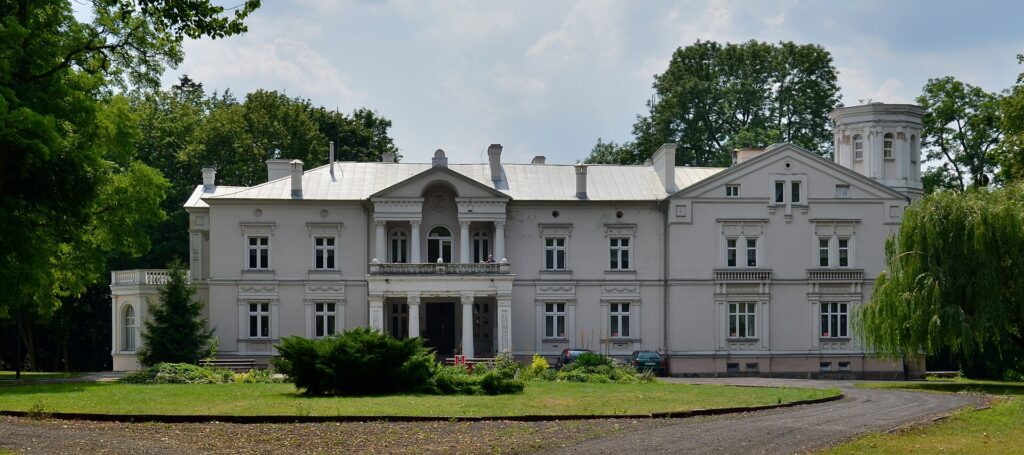
In Ugoszcz, by a lake in Brzuze municipality, stands an eclectic palace with a tower and a pentagonal orangery. It was built by the Borzewski family, who owned the estate for almost a century and a half. Fryderyk Chopin very probably visited the earlier manor on this site, and more than a hundred years before that a hunted archbishop hid here. Today the palace houses a care home, so you view it from the gate.
An archbishop in hiding and a family from Szafarnia
Ugoszcz appears in documents in 1418. At the beginning of the 18th century the estate belonged to the Zieliński family. The owner's brother, Archbishop Konstanty Zieliński of Lviv, crowned Stanisław Leszczyński king. For this he was pursued by supporters of Augustus II the Strong, so he took refuge in Ugoszcz. Wikipedia gives the year 1704, while the Fryderyk Chopin Institute gives 1705–1707.
In 1790 the estate was bought by Ludwik Borzewski, and his family farmed it until the Second World War. Honorata Borzewska came from Ugoszcz. She was the second wife of Juliusz Dziewanowski, owner of Szafarnia, where Chopin spent the holidays of 1824 and 1825. The composer mentions Ugoszcz in a September 1825 letter to his friend Jan Białobłocki. According to the Chopin Institute he almost certainly came here more than once. The manor he visited no longer exists.
A palace with a tower and an orangery
The present palace was built by the Borzewskis in the second half of the 19th century. The Chopin Institute dates it to the 1860s, while the register of monuments gives 1875 and 1904. A pentagonal orangery was added on the east and a projecting wing topped with a two-storey tower on the west. At the front there is a columned portico.
The palace stands on a high lakeshore and is surrounded by a wall. A long avenue leads from a gate with a decorative grille to a circular drive in front of the entrance. The Neo-Rococo entrance gate dates from the second half of the 19th century. The park was laid out by Antoni Borzewski and redesigned after 1904 to plans by Stefan Celichowski. Antoni was killed in Ugoszcz in 1920 while defending the estate during the Polish-Soviet War.
School, health centre, care home
After the Second World War the state took over the estate. The palace served in turn as a school, a farmers' club, a library, a shop and private flats, and in the 1970s as a health centre. Today it is the main building of the "Kombatant" care home. The whole complex, the palace, the park and part of the manor farm, has been listed as a historic monument since 17 September 1985.
Practical information
Ugoszcz lies in Brzuze municipality (Rypin County, Kuyavian-Pomeranian Voivodeship), by Lake Ugoszcz. Residents of the care home live in the palace, so view it from outside, from the gate and the avenue, and do not enter the grounds without permission. A quarter of an hour is enough for a short stop. Ugoszcz combines well with other Chopin-related places nearby: Szafarnia and Sokołowo.
Why it's not a historic gem
The palace is a care home and is not open to visitors — no physical access.
Sources
- Ugoszcz — katalog miejsc Chopina, Narodowy Instytut Fryderyka Chopina — https://greatcomposers.nifc.pl/en/chopin/catalogs/places/122
- Ugoszcz (województwo kujawsko-pomorskie) — Wikipedia — https://pl.wikipedia.org/wiki/Ugoszcz_(wojew%C3%B3dztwo_kujawsko-pomorskie)