Municipality of Czerwonak
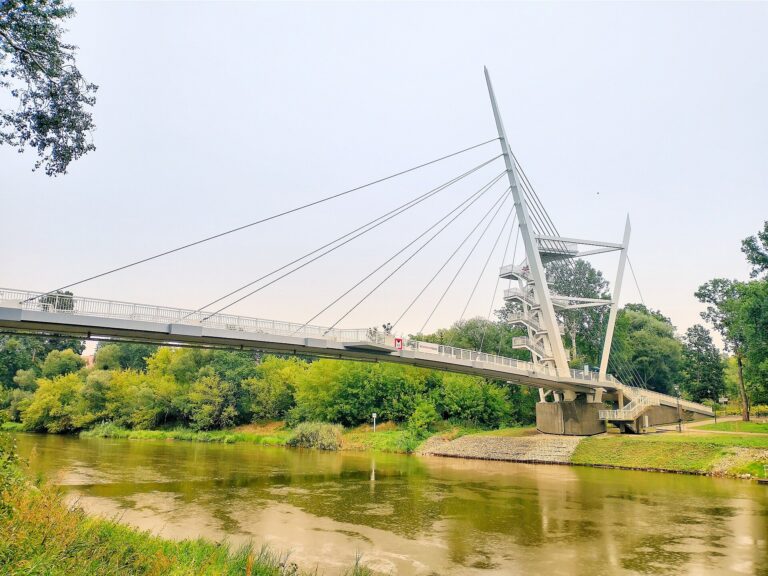
The Owińska Footbridge — where a ferry ran for 700 years
A footbridge over the Warta with a 25-metre viewing tower, on the site of an old ferry crossing.
Read more →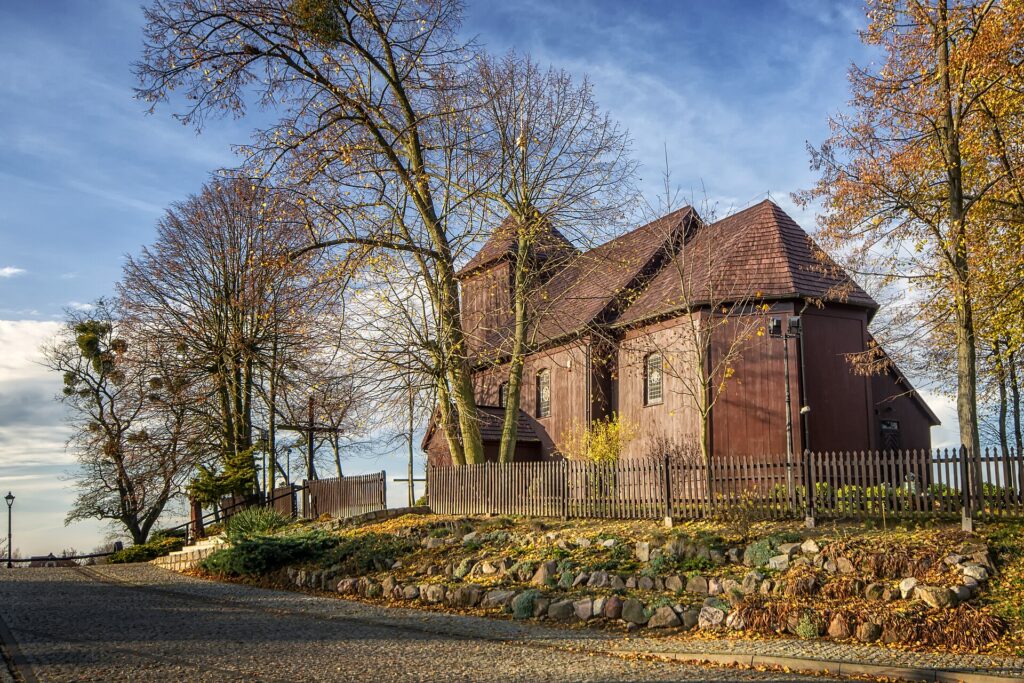
A larch-clad church from 1751 and the true story of Jan Kochanowski as parish priest of Kicin.
On a small rise in the middle of Kicin, above a cobbled street, stands a dark brown church clad in larch boards. This is the wooden parish church of St Joseph, Spouse of the Blessed Virgin Mary, built in 1749–1751 on the edge of the Puszcza Zielonka forest in Czerwonak municipality. It looks modest, but it is nearly three hundred years old and connected to a name every Polish schoolchild knows: Jan Kochanowski.
This is the most often repeated — and most often distorted — fact about Kicin. From 1564 to 1574 Kochanowski, the great poet of the Polish Renaissance, was provost of the Poznań cathedral chapter, and that dignity came with the Kicin benefice: the income from Kicin and several nearby villages. Formally, then, he was the parish priest here. Pastoral and administrative duties, however, were carried out on his behalf by vicars, and the poet himself — as the sources agree — never visited either Kicin or Poznań. He gave up the benefice when he decided to marry.
It is also worth knowing that the church you see today is not the one from Kochanowski's time. The first church, dedicated to All Saints, was mentioned in 1405, although Czerwonak municipality suggests the parish may date back to the 12th or 13th century. The old church was pulled down in 1749, and the present church was built on its site in 1749–1751. According to the heritage register, it stands on the site of a former hillfort in the centre of the village.
The main founder of the new church was Józef Tadeusz Kierski, Bishop of Poznań — who, before becoming bishop, had himself been parish priest in Kicin. In 1752 he consecrated the church in person. The building has kept its original log construction of pine beams: it is 19.46 metres long, and the nave is 8.69 metres wide. The church has a rectangular nave and a narrower chancel with a three-sided end. The outer walls are clad in vertical larch boards, and on the west side stands a square post-and-beam tower with a porch and a tall pyramid roof. The roofs are covered with slate.
The building has survived almost three centuries thanks to a series of repairs, which the heritage register lists in detail. In 1830 the cemetery was moved, and in 1852 the tower was destroyed; it was rebuilt in 1863. In 1902 the roof was covered with slate, and in 1903 the floor was replaced. In 1980 the wall cladding was replaced, in 2004 the sacristy, and in 2008–2010 the interior was conserved.
The interior is kept in shades of blue, with Rococo paintings featuring garland motifs. Their history is surprising. In 1931 the walls were covered with new paintings, and the original 18th-century decoration was only uncovered and restored in 1966–1967 by Teodor Szukała. A simple flat ceiling separates the nave from the chancel. The mid-18th-century high altar holds a painting of the Virgin and Child, which the heritage register dates to 1687. The church also has a painting of Our Lady of the Snows from about 1620–1630 and two Neo-Baroque side altars. The Rococo pulpit and the font, among other fittings, date from the time of construction, and there are also three patrons' pews.
In the year the church was consecrated, four bells were cast and named Joseph, Nepomuk, Stanislaus and Lawrence. Next to the church stands a bell tower from 1985. Czerwonak municipality says that in 1997 three new bells made by Józef Hryniewski of Kicin were hung in it.
During the occupation the Germans renamed the village Buschdorf and set up a forced labour camp for Jews on the parish premises. It operated from 1 July 1941 to 25 August 1943 and was one of at least 22 such camps the Germans created in Greater Poland at the time. Prisoners were brought from the Łódź ghetto and from Zgierz and Pabianice, with individuals also from Kutno and Włocławek. Around 40 men aged 20–50 were held here at any one time; in total about 114 people passed through the camp, and 76 of them died.
The prisoners built the road to the village of Kliny, paved roads in Czerwonak and did field and clean-up work. They lived in hunger and cold, sleeping on bare ground or on bricks. Accounts survive of beatings and of prisoners being hanged for trying to take a few potatoes from a field, as well as of reprisals against Poles who tried to pass them food. When the camp was liquidated, the survivors were deported to Auschwitz-Birkenau.
On 27 January 2017, International Holocaust Remembrance Day, a plaque commemorating the prisoners was unveiled at the site of the camp. It was initiated by the mayor of Czerwonak, the then parish priest of Kicin and the Poznań branch of the Union of Jewish Religious Communities. The information about the camp comes from historians' research, including that of Dr hab. Witold Tyborowski of the Institute of History at Adam Mickiewicz University, author of a monograph on Kicin published in 2016 for the village's 700th anniversary.
Getting there: Kicin, ul. Kościelna — the church stands on a rise in the centre of the village; the "Navigate" button takes you to it. The Wooden Churches Trail around the Zielonka Forest, the Greater Poland Way of St James, the Independence Trail and the August Cieszkowski Trail all pass through Kicin. Since 2016 a Rosary Way has also linked Kicin with Wierzenica. A visit is therefore easy to combine with a bike trip, for example to Dziewicza Góra. Visiting: this is a working parish church — you are most likely to see the interior around services; at other times it is worth contacting the parish in advance. During Lent the parish stages a Passion Play — dates are on the parish website. Time: 20–30 minutes. Mass times and access to the interior may change — check before you set off.
A footbridge over the Warta with a 25-metre viewing tower, on the site of an old ferry crossing.
Read more →The highest point of the Zielonka Forest — and the key to where the name Czerwonak comes from
Read more →A park where blind children learn to move around on their own — open to you too
Read more →