Municipality of Śliwice
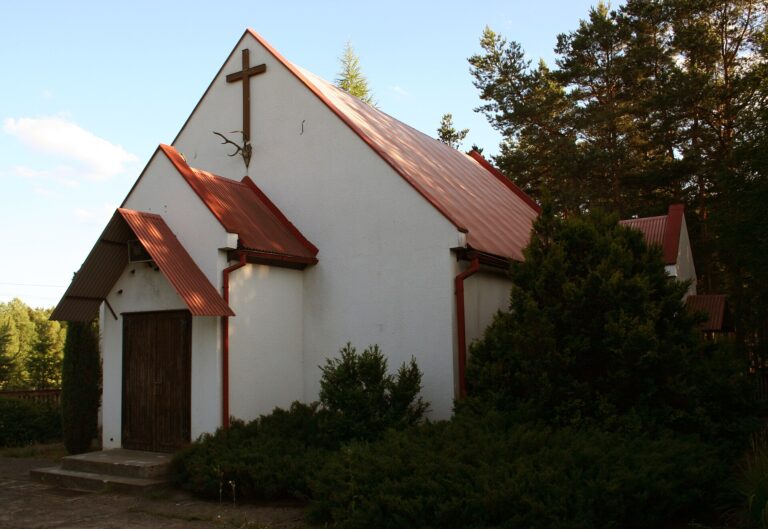
St Hubert's Chapel in Okoniny — sanctuary of the patron of hunters and of the whole municipality
A chapel with antlers on its gable, relics of St Hubert and a November hunters' feast.
Read more →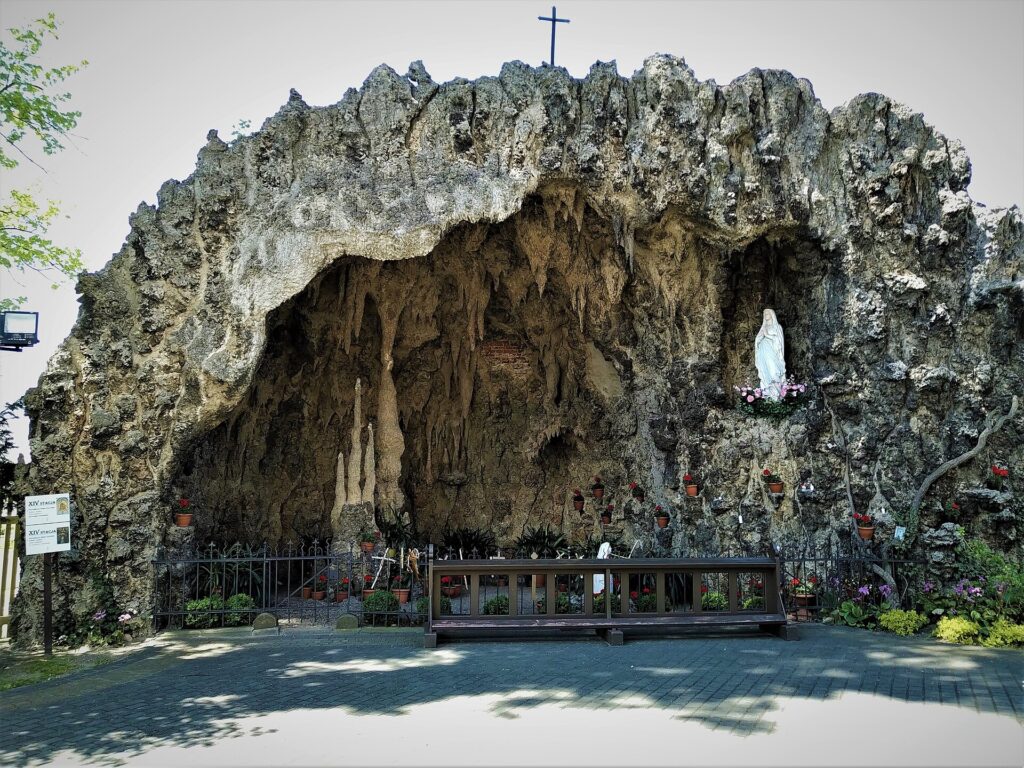
A grotto cast from slag and cement in 1908, and gravestones made with the same technique.
By the church in Śliwice, right in the middle of the Tuchola Forest, stands a grotto that from a distance looks hewn from rock: overhangs, stalactites, a niche with a statue of the Virgin Mary. Up close you can see it is not stone. The grotto was cast in 1908 from slag mixed with cement — and the same technique, a few hundred metres away, was used to make gravestones that are hard to find anywhere else.
The grotto was built for the 50th anniversary of the apparitions at Lourdes (1858) as a faithful copy of the grotto there. It was initiated by Father Dr Stanisław Sychowski, who led the parish from 1896 to 1916 — the same priest who enlarged the church and championed "organic work" in Śliwice; the street with the municipal office bears his name today. The work was supervised by a builder from Bavaria. According to the municipality's description, slag was steamed at about 70°C, mixed with cement and poured onto a wire-mesh frame — hence the irregular, "rocky" texture that mimics a natural cave from afar.
The grotto is part of the church complex listed in the heritage register (no. A/268, 2004) together with the church, the churchyard and the 1830 fence with its gates.
A parish in Śliwice was mentioned as early as 1339. The present Gothic Revival church of St Catherine of Alexandria, built of brick and fieldstone, dates from 1830–1833; in 1901–1902 Father Sychowski enlarged it with a three-aisled body and chancel designed by J. Konitzer of Czersk. A Baroque two-tier high altar from the second half of the 17th century and two Renaissance bells come from the earlier church.
The 1830 church was not the first. The Tuchola County guide says the first, wooden church in Śliwice was built in 1263–1264 and another in 1618. In the 13th century the village belonged to the dukes, and in 1339, under the Teutonic Order, it received Chełmno town law. After 1772 Śliwice came under Prussian rule. The guide notes that the village's social and patriotic life was then driven by priests: Fr Teofil Krzeszewski and Fr Sychowski, who initiated the grotto.
The “Orfeusz” choir, founded in 1873, also dates from this period. The guide calls it the oldest village choir in Poland. A People's Bank, a water company and a basket-weaving school were set up at the same time.
About 300 metres from the grotto, in the parish cemetery (listed as a heritage site in 1993), stands a group of gravestones from about 1906–1917. A local workshop made them with a technique very close to the grotto's: mortar applied to steel mesh. They mix Art Nouveau, Romantic and Gothic Revival motifs, and their form echoes the grotto, the rich turn-of-the-century decoration of the church and the chapel of St John of Nepomuk that stood by the cemetery entrance until it was destroyed in the Second World War. Śliwice municipality describes the group as an example of small funerary architecture with no counterpart in Poland. The main cemetery avenue ends at a Calvary with ceramic figures of the Crucifixion group, brought from Bavaria in 1900. The same cemetery holds the common grave of about 174 Jews murdered on 16 February 1945 — we describe it separately: The grave in the cemetery in Śliwice.
Getting there: Śliwice, ul. Kościelna / ul. ks. dr. St. Sychowskiego, in the village centre by St Catherine's church; the "Navigate" button takes you to the grotto. The parish cemetery is about 300 metres away, and the former Protestant church a few hundred metres from the grotto on the same street. Access: the grotto stands in an open square by the church; the cemetery is open during its opening hours. These are places of worship and remembrance — please respect services and funerals in progress. Time: 30–45 minutes for the grotto, the church from outside and a walk through the cemetery. Church and cemetery opening hours may change — check before you set off.
A chapel with antlers on its gable, relics of St Hubert and a November hunters' feast.
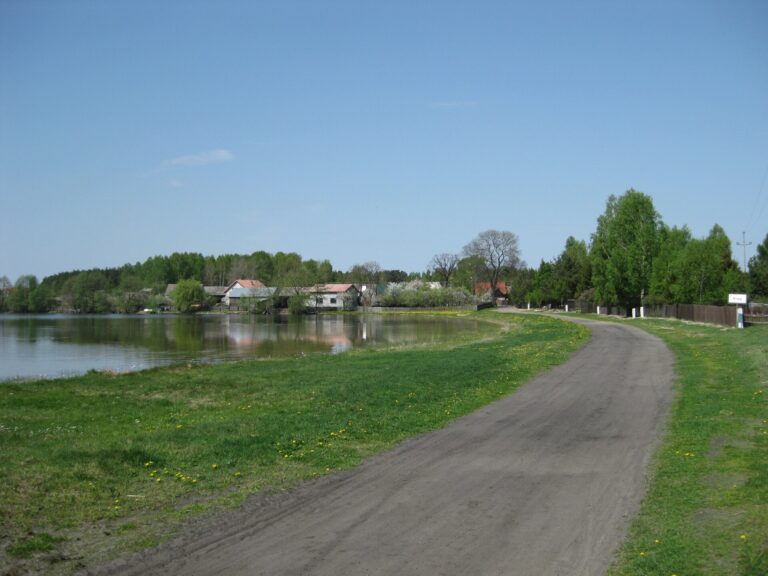
Read more →A village on an isthmus between lakes, where most houses are old cottages of pine logs.
Read more →